Then look at this:
Friday, February 19, 2010
From the Grass-fed Duh Files
Then look at this:
Monday, February 15, 2010
Natural Pest Control Product
Occasionally, though, the bugs go crazy and attack everything. In that case, you need an organic and natural pest killer. Our friend Jackie (who makes great Hawaiian perfumes and body butters) recently started Natural Pest Free, which sells cedar-oil-based natural pest control products.
CEDAR OIL for more than a 1000 years is and has been a proven method of pest control that emphasizes simple, inexpensive, 100% organic practices that cause no harm to people or the environment. CEDAR OIL focuses on building a barrier of entry on the perimeter of your property, so bugs stay out of your yard, which means they stay out of your home. At Natural Pest Free we are dedicated to reducing the health risk and environmental impacts of pesticides and promoting organic alternatives to homeowners across America, one home at a time.
I'm a big fan of the natural barrier plan. I surround my garden with rows of clover
So, a cedar oil barrier makes sense for keeping the bugs out. I suggest using it sparingly, mostly when there's a serious infestation of something you really need to stop. Remember, when you're gardening, most bugs are beneficial, so you don't want to just keep all bugs out.
But in your home is another matter. This is a great product for use as an in-home pesticide.
...control of Head lice, Mosquitoes, Flies, Fleas, No-See-Um, Chiggers, Ticks, Chinch Bugs, Grub Worms, Mites, Mole Crickets, Earwigs, Slugs, Snails, Caterpillars, Beetles, June Bugs, May Bugs, Root Maggots, Army Worms, Weevils, Wire Worms, Ants and Termites.
Way to go Jackie! I'm proud to be affiliated with such a fine product!
Tuesday, February 02, 2010
Cold Climate Composting
Last winter, though, my compost pile (which, by the way, lowers my carbon footprint considerably, since that food waste won't decompose anaerobically in the landfill) froze solid, like a big block of ice. It was my first real winter after years of living in substantially warmer climates. This year, I was ready for these sub-zero temperatures. With a couple of bags of hay, some very dry, aged horse manure, and a lot of snow for insulation, I have built a very insulated compost pile.
Since I'm lazy, the pile is up against the foundation of the house, right at the bottom of the back stairs. I don't want to have to put on the snow shoes to compost all winter. This way, the compost is only exposed on three sides. On two of those sides, I've stacked flakes from the hay bales, creating a kind of straw bale shelter for the pile. The front is open, but held up about 18 inches with some chicken wire fencing, which I have now piled snow up against for insulation. The top of the pile is covered with snow, which I poured hot water down to create a cylindrical hole down to the top of the pile.
Now, when I want to compost
But underneath all that lies the compost pile proper, where my probes have proven that composting is taking place, worms are thriving (future turtle food), and aerobic decomposition is reducing our carbon output. But the best part, of course, is that come spring, when I build some new raised beds
Of course, if you have a little money to spend, I imagine a black plastic composter
Sunday, January 24, 2010
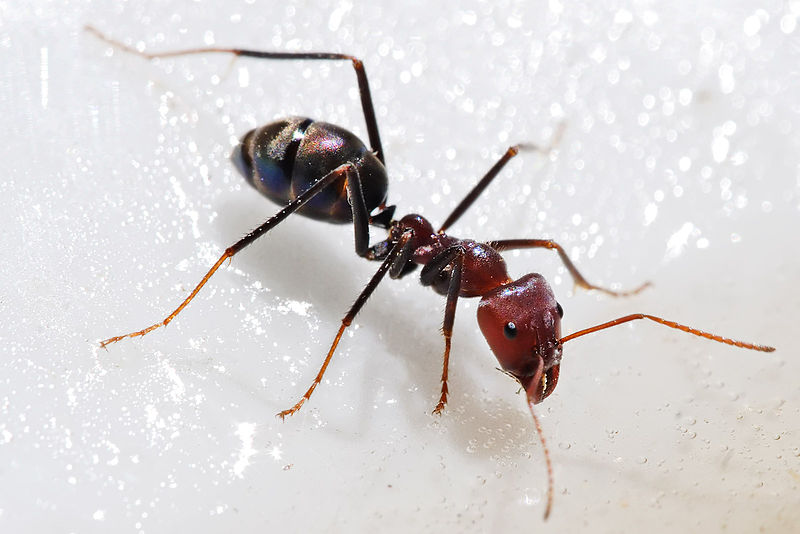
Ant Wars!
Ants go where the food is, so first, make sure there's nothing for them to eat. This is most important! Cut off their supplies!
Now the battle can begin!
Put out the ant baits you can buy anywhere, but put them outside near their homes. I used to use those metal stakes that go in the ground. They work for a while, but eventually they learn to avoid them, so you have to keep changing brands. This is the artillery to soften them up a little.
Find where they're coming through the wall. Unless they're under the house, or living in the house somewhere, they're coming in through a crack, usually around a cable inlet hole or window. Caulk. You want to seal the holes anyway, for energy efficiency.
Now you're going to have to launch an attack on their fort. Follow their trail back to the home. If you don't care about growing anything in that spot for a while, pour a bunch of vinegar down the hole. Get the 10% vinegar if you can find it, but 5% is OK. If you dig the area up after wards and compost the soil with some grass clippings and food waste, it will balance out the pH and you can use the soil again.
If you really want to have some pyrotechnic fun, I suggest gasoline of kerosene. Not exactly organic, but you're going to let it soak in and then light it up. Careful. I suggest some sort of fuse so you can stand back when the fire geyser spews flaming ants into the sky.
If they're really bad, there is an ant chalk that is technically illegal, but they sell it in Chinatown. It has a neurotoxin in it, so use gloves, and make sure the kid can't get near it. It's not technically organic, although a lot of people say it is. The active ingredients are Cypermethrin and Deltamethrin, which are both common, very weak insecticides which break down quickly (but are really bad for fish, so don't use near water). They are both Pyrethroids, synthetic chemicals that very closely resemble pyrethrins, which come from flowers. This is what a lot of ant sprays have in them, but I hate sprays as a lot of it gets in the air that way. Besides, they stink for days after you spray them.
Draw chalk lines where the ants are coming into the house, on concrete it works well, you have to press hard to make sure it gets into the stucco. They will not come back for a long time once they get a taste of that stuff.
Finally, learn to live with a few of them. Too many and there's obviously a food source available, so again, make sure every thing's sealed up. Battle them back as much as possible, but there will always be scouts. Kill them when you see them, but no need to freak. They're actually pretty clean, an amazing evolutionary engineering wonder. The colony acts like a single brain (I often call it the ant brain).
And they're just doing their (very important) job....
Saturday, January 09, 2010
Community Supported Agriculture
Our local and organic grass-fed highlander beef (very lean), which we use for our Happy Hobo Grass-fed Beef Jerky, is from Nectar Hills Farm, which recently started an upstate New York CSA of their own, mostly for meat (they also have lamb, pork, poultry, eggs, and cheese), but also other things from the farm, like incredible organic produce during the season and organic red bamboo honey (which we also use in the beef jerky).
Nectar Hills Farm also has a new farm picture gallery, if you'd like to see some pictures of a small organic farm in upstate New York.
CSAs aren't new. You can find one near you on the Local Harvest's CSA finder. They're a great way to help your local farmer. It gets them money when they need it, and it gets you a discount on farm-fresh local and organic products on a regular basis. This food is better for you, better for the animals, and better for the environment. It is money you won't spend keeping big agri-business in business.
Our New Year's resolution is to stop eating corn-fed and factory farmed beef. You don't have to be that drastic about it, but once you research grass-fed beef in your area, you'll find an array of delicious meats that are essentially solar powered, instead of oil and corn powered, like the concentrated feed lots of industrial meat production.
Friday, December 18, 2009
Robin's Best Grass-fed Beef Jerky Ever!
The grass-fed Highlander's top round that this batch of jerky is made from is, as we're told, as good as they get, having spent the whole summer eating grass from the fields of Nectar Hills Farm here in central New York's leatherstocking region. When the cows have been out in the fields eating grass all summer, they fatten up and become especially delicious.
Of course, Robin thinks it's cute that I say every batch of jerky is the best. But I'm serious. She's perfected the recipe, the cows are particularly delicious this time of year. And we've switched to organic tamari to replace the soy sauce (we're making a special batch with no wheat, which soy sauce contains, for some relatives who can't eat wheat). At this point, the only wheat left in the recipe is the trace amount in the organic Worcestershire sauce, so to make a wheat-free jerky, we just leave that out.
Starting this winter, we're going to begin experimenting with other flavors of jerky. We're thinking Teriyaki, tropical, and a few others. Suggestions are certainly welcome!
We're also going to experiment with organic dog treats, but don't tell your dog yet; we want to get it just right first.
If you can't make it to the Cooperstown Farmer's Market Saturday morning, you can order our grass-fed beef jerky at the Nectar Hills Farm website.
Wednesday, December 16, 2009
White House Hoops
Good looking and inexpensive hoop houses are the focus of this White House Blog post by Sam Kass, assistant chef and Food Initiative Coordinator for the WH.
Glad to see they're growing all my favorites, especially mustard greens! I wish I'd had the time to put in some hoops over my greens. Too busy of a year-end for us to get out there and do much.
I'm looking forward to seeing what lives through being mulched, buried under a blanket of snow for a few months, and then uncovered in the spring. I know the spinach plants will start up again, but I also mulched some small mustard, collards, mizuna, and miner's leaf lettuce.
So, I'll just think of not having hoops out there as an experiment into what survives the winter up here in zone 5... If you mulch it, will it come back?
Tuesday, December 08, 2009
White Hoop House
I put up some plastic last year and made a little hoop house to protect winter greens. It was hastily built just in time for a surprise snow storm around Halloween.
This year, I just picked the greens down as low as I could, and mulched them with old straw over a layer of very dry, aged horse manure. I know the spinach will come back in the spring, and I suppose the mustard, mizuna, collards, kale, onions, radishes, and other cold hearty vegies will survive as well.
If not, whatever dies will compost under all that straw, which is now under a few inches of snow. It stays pretty warm under that white blanket--warm enough for things to decompose if not actually live.
This spring, or late winter, if I have any money, I plan to build a slightly larger hoop house, something I can actually walk into instead of crawling under (I have a bad back), and that will get me started much earlier.
In the mean time, I'm going to look into these little hoops at the White House, as maybe they'll make a good low-cost alternative to the big one, and I'll just have to figure out a way to get under there more easily.
Saturday, November 21, 2009
New New York Grass Fed Beef Pictures
Sonia tells us that she and Dave are working out the details for a CSA (community supported agriculture) that they will be offering soon. Nectar Hills Farm sells grass-fed free-range beef, pork, and other meats, plus farm-fresh eggs, honey, cider, and produce. You can find out about CSAs in your area at Local Harvest.
If you're bored, I recommend checking out the Nectar Hills Farm Links page, which has all kinds of fun links, like the American Livestock Breeds Conservancy and the Josephine Porter Institute for Applied Biodynamics. Fun stuff!
Wednesday, November 11, 2009
Would You Eat a Monkey?
Of course, I was a kid more obsessed with beer and girls than ethics, but later in life, after studying bio-ethics and getting a philosophy degree, the smart pigs haunted me. Eventually, when I got old enough to worry about my cholesterol and whether I was doing the right things, I really started to feel bad about eating pork. The more I learned about factory farming, the worse I felt. I never thought I would say it, but I started losing my taste cravings for bacon (I used to joke that a pile of crap would taste good with bacon and cheese on it).
Then I learned about Michael Pollan. I heard him make the argument that pigs are at least as smart as dogs (in reality, new research shows that pigs are much smarter than dogs), and you wouldn't eat your dog, so why would you eat pork?
As ethical arguments go, that's a damn good one.
After that, I was convinced. A few months later was the Chinese New Year, starting the year of the pig. I convinced my fellow prosciutto loving wife Robin to quit with me. And we've been pork free for almost three years now. Even our son has joined the cause.
Since we moved to upstate NY, we found Nectar Hills Farm where they treat their animals with respect. The pigs are free range and appear happy. To be honest, they look delicious. But I'm still not eating them. However, if you can get past the intelligence problem (I've also stopped eating octopus due to research that shows how intelligent they are), then you should at least consider only eating free-range pork. The evils of factory farming are impossible to deny, from the treatment of the animal to the effects on the environment (see the chapter on massive pig shit geysers in Senator Al Franken's Book Lies and the Lying Liars Who Tell Them
Recently, I had been debating around the edges with questions like eating wild pigs (which are very bad for the environment, especially in places like Hawaii) and I'm still not sure about that. Possibly. But I don't think I would eat a monkey that was messing up an ecosystem somewhere, so...
These are tough questions. We all have to come down where we decide. For me, it's a question of how smart an animal will I eat? For now, I'll stick to the oblivious seafood (but only the good stuff per the Monterey Bay Aquariums Guide to Sustainable Seafood), idiot chickens and other birds, and the only slightly smarter cows (but we're moving to only grass-fed beef as much as we can afford). The environmental choices are actually pretty easy: eat free-range, organic, grass-fed, pasture raised, keep it as local as you can, and stay away from factory farmed as much as possible.
Choosing what you eat based on the intelligence of the food? Well, I'll just have to keep thinking about that, and adjusting along the way. It's the least I can do for a species that looks, based on this new research, to be at least as smart as dolphins.
As Dr. Lawrence Schook said in yesterday's NYT article, "Pigs like to lie around, they like to drink if given the chance, they’ll smoke and watch TV." When I'm coming up with rules to live by, this one comes up near the top: I just can't eat anybody who would sit around with me watching a movie (Animal Farm?) drinking beer, and puffing on a good cigar.
Photographs of Nectar Hills Farm by Robin Supak.
Tuesday, October 13, 2009
What the? Oh, go to...
Snow.
This whole cold thing is new to me. Last year, we moved in too late to have a real garden. This year, I get to go out there and see pepper plants that never really had a chance to produce more than a few token reminders of heat, now all post-frost droopy, just waiting for me to get out there and compost them.
I just don't have the energy, partly due to some bad pain days lately, but also because I'm an inherently lazy gardener, and I figure the winter will lay all the dead stuff flat and compost it under the snow anyway. If anything, I should throw some straw and leaves on there.
I'm getting damn good at growing the cold lovers: collards, mustard greens, kale, spinach, some lettuce--all doing great. I'd forgotten how much I like mustard greens--very spicy! Almost makes up for the lack of jalapenos...
We stopped on the side of the road and bought some bags of aged horse manure ($2 for a big bag from an honor cart--stuff the money in the hand-cut slot on the top of a plastic Folgers container), and I've layered it on top of some spots where I'm going to put peppers and other nitrogen hogs (my kingdom for a home grown tomato) next year. So, the soil bank deposit has been made, or at least part of it. I'll be putting more compost and manure out in the next few days, and then again in the spring.
I also have some clover seed I've scattered here and there, that I will turn in in the spring as a green manure. Clover's a good cover crop, and it keeps the rabbits busy so they'll stay away from the radicchio that's almost done. Or so the theory goes.
Kind of like that theory that it gets warm and sunny in the summer...
Thursday, September 17, 2009
A Shiny Thing from A Reader!

Thanks for the shiny thing, reader, whoever you are. We just love recognition (never mind that that means to "think again"), especially when there's something ribbon-like involved. In the early days of the web, when we were some of the only people on line giving out organic gardening advice, peddling Mort Mather's Organic Gardening Essays to whomever would listen, we would get awards on a regular basis. Now? Not so much.
So thanks, reader! It was almost as nice a present to wake up to as the organic Kona coffee my Hawaii coffee farming friend Michael keeps sending! If anyone else wants to do something nice for us, let me know! If you can't afford to help us pay the rent by supporting our advertisers (buy a poster, man, they're cheap and cool), then find a place to submit us!
Put a link on your site (this little linking logo works really well for that), or your facebook, get a Supak.com tattoo, or something!These little gifts mean a lot more to us right now, a very stressful time for us. So, seriously, thanks. A little "thinking again" goes a long way.
Wednesday, September 09, 2009
It's About to Get Cold So I Think Hawaii
Yesterday I'm out there thinning collard seedlings* that are growing where I should be picking tomatoes, and bringing in handfuls of yellow squash, zucchini, green beans, carrots, radishes and whatnot, thinking, no tomatoes, but not so bad. And then, as if to remind me that the cold is on the way, I get this picture in my email from my Innkeeper friend Cherie, who runs the Hale Hookipa Maui bed and breakfast.

That's quite a haul, all from one day she tells me... Well, put my little pile of squash in perspective, will you! Cherie also runs this volunteer on vacation in Hawaii site, and a great Maui blog. If you like tropical gardening (she also has great flowers), check it out. Or better yet, check in for a week. Maui is a gardener's paradise. But beware, in the depths of winter in upcountry, you might wake up to a cool 55 degree morning!
* Planted from the seeds from the greens I let overwinter last year, in an attempt to make them even more cold hardy. I will let some of these go over winter again, to seed in the spring, for seeds for next fall's crop. I never really learned this technique, it just seems to work well, and my theory is that anything that can stay alive over winter here deserves to be propagated. At least that way, if we keep having summers that weren't, I'll have some cold hardy greens to grow any time of year!
Monday, August 24, 2009
Rural Blight
So it was with great surprise that I woke up the other morning, poured my cup of organic Kona coffee, and went for my walk-through to see how much radicchio and pea sprouts the rabbits had dined on before the hot pepper spray sent them running for water (I just love imagining that, since, for Robin's sake, I'm suppressing the urge to shoot the little buggers), and low and behold, I found the dreaded rural blight, growing all over my tomato plants like some kind of brush fire that had made it's way into a neighborhood.
It happened overnight, like the graffiti that wound up on a wall near our place in LA. But I couldn't just paint over this blight. This is the dreaded tomato blight that has decimated tomato gardens all over New England this summer that wasn't.We thought we had avoided it, as it got warm and drier over the last couple of weeks... Bam! Hurricane comes up the coast, cold front comes down from Canada, and one night of cool, wet conditions, and there it was. It literally happened overnight. There may have been some signs the day before, but they weren't that noticeable, and I was being very wary.
I've ordered some copper spray for the big plant next to the house, that volunteered from the compost. It's only showing small signs, and I've been pulling off any leaf with even a speck on it. Maybe the spray will help. Or, maybe, tomorrow, I'll be pulling it up and shoving it in a plastic bag, like some murder victim on Law and Order. Bagging up all the plants yesterday looked like a battlefield...
We had a lot of tomatoes. Almost all started from seed. Many heirlooms. Much pain. Almost like losing a pet.
We have several bowls full of green tomatoes that we're going to make a nice relish with, but damn.... seriously, We're going through the seven stages of grief here.
Thursday, August 20, 2009
One way to beat a short summer: speed!
Clem: They say you should lock your car doors up here in the summer.
Me: Really? I thought no one ever locked their doors up here.
Clem: Well, in the summer, if you leave it open, someone might put a zucchini in it!
They got a late start this summer that almost wasn't, but boy do they make up for it in speed. I was right to plant so few plants (we have two). I guess that's the nature of squash. I have about 5 pumpkin plants that we use mostly for the blossoms (lightly breaded and fried), but it's amazing to me that between now and the end of October, a whole damn pumpkin will appear, grow to size, and ripen.
Saturday, August 15, 2009
Doing the Right Thing
This is why I'm an organic gardener. I want to be ethical toward the planet. It's why I stopped eating pork: it's one of the biggest industrial farming nightmares because pig shit is impossible to deal with on a large scale. Small scale pig farmers argue that they've solved that problem by, well, being small (which allows nature to deal with the waste), and maybe they have a point. But I have another ethical guide of my own to follow, which is that I don't want to eat animals that are more intelligent than a dog. That means no pigs, and no Octopus.
We have a lot of friends who share our basic ethical positions, like the grass fed beef farm down the road, the gourmet grocery in Cherry Valley, and even older friends back in Hawaii (where we lived for a year) like this organic Kona coffee farm, and Cherie Attix who has put her money and effort where her ethics are and created a new web site and discount program for her Maui bed and breakfast (where she has a wonderful organic tropical fruit garden) that encourages and rewards volunteer vacations in Hawaii. Volunteer while you're on vacation in Hawaii, and you'll get a 5% discount off your stay at her historic Inn, and she'll donate another 5% to the organization for which you volunteer. Most of the volunteer programs are environmental in nature, like eradicating invasive species and planting native ones.
So keep in mind that wherever you are, and wherever you travel, you can take a little extra time, a little extra money and save us all in the long run by doing the right thing. Buy your garden vegetable plants from a local nursery and you'll help support your local economy and help stop the spread of the late blight. Buy local and organic food and help your health and the planet's. When you camp somewhere, pack out what you pack in. When you go on vacation somewhere, volunteer while you're there. Volunteer to help your own community. Just do something that's right. It's really a lot easier than the corporate interests want you to think.
Friday, August 14, 2009
Oh, that's what those poles are for...
Sunday, August 09, 2009
Wednesday, July 15, 2009
Peppers Need Sun
At first I thought it was the cold (nights often in the low 40's even in July, for Chrissake), and I had some plants in starter trays that I would bring in at night or in the rain. But even on cloudy days with no rain the slugs were out and hungry, and there goes a pepper plant... and another...
Ah, the learning curve.
We've had a few days of sun in a row, and the nights look like they're going to stay above 50 for a while now, so maybe at least these "cool weather jalapenos" (oxymoron?) will have a chance.
Even with the decimation, life finds a way. Lots of water, I've discovered, means lots of weeds (even with all the early weed killing I do using the lazy man's weeding method in early spring). But it also means nice soft soil, plenty of growth in wild berries and other foragables. Oh, and now plenty of insects! It was great when the lightning bugs were going at it every night, but now I'm seeing more results of wetness: mosquitoes and other hungry bugs eying the vegies. Having the birds around is helping keep the numbers lower than they would otherwise be, so good thing I've been feeding them all winter.
My empathetic agnostic friend has a great insect game he plays while gardening that he wrote about in his latest post, What is Heaven Like?
The heaven I have found is a place where everyone loves everyone. Other than that it is pretty much just like life here on earth. I envision a party with friends and at this party there is a game that we can play. We step into this closet or put on a virtual reality suit and we are “born” into this life. Just like with games as we know them here on earth we can play the game over and over and each time we get better at it. Before stepping into the game we can think about how we will play it. We may give ourself certain goals and pick a time and place to be born. Our friends on the other side can come into our game and be characters helping us, challenging us or testing us.
Here is an example of how it works.
I am an organic gardener and one of the things that takes up a fair amount of my time is chasing stripped cucumber beetles (CBs) on my squash plants. I have decided that the cucumber beetles are some of my friends from the party. They were hanging around the punch bowl watching me and…
CB 1 Let’s play hide and seek with Mort in the squash patch.
CB2 I’m game. Let’s make a side bet on who lasts the longest.
CB3 I know what I’m going to do. When he spots me I’m going to drop off the leaf.
CB1 Yeah, that works pretty well where he has mulch but he can spot you on the ground.
CB 2 I’m going to fly.
CB 4 How are you going to fly out of a blossom?
CB2 I’ll be on a leaf and keep my eye out for him.
CB 4 If I know you, you’ll be in a blossom screwing and when he comes along you will be oblivious. Your lady friend will probably start running and you won’t even get off her.
CB2 I guess you’re right. I’m not going to waste a life just hanging out. Maybe I’ll get lucky and he won’t see me.
This dialogue goes on as I mercilessly move down the row of squash plants picking off CBs, chasing those who drop onto the mulch and tunnel in, who drop and play dead or who drop and run. The blossoms will frequently have several mating couples making me think of a luridly painted yellow motel. Sometimes they will see me coming and watch me ready to fly if I move toward them. These I have learned to catch with a swift grab but others fly immediately and escape. This heaven I have invented helps me get through a job that might otherwise frustrate me perhaps to the point of anger. Instead of anger I am feeling playful and forgiving.
I've always wondered about you north easterners. But, hey, whatever gets you through the
Friday, June 19, 2009
Less weeds means more work?

Well, different work. Because I use the lazy man's weeding strategy, once things get going in the garden, I only have to weed the few blow-ins occasionally, and that means I get to help out with the fun stuff, like making and bagging our Happy Hobo Grass-fed Beef Jerky. Grass-fed beef is better for you, the animal, and the planet. Our latest batch is mostly the very popular Ommegang Hennepin Ale and Jalapeno Jerky, which is available today at the Nectar Hills Farm Store in Cherry Valley, and tomorrow at the Cooperstown Farmer's Market. You can, of course, purchase our grass-fed beef jerky on-line through the Nectar Hills Farm site for now, until I finish working on the jerky web site. Good thing there aren't too many weeds!
Indeed. Then there's Robin's Biscotti, which is now just one of the deserts by Robin that are available at the Rose and Kettle Restaurant here in Cherry Valley, a great restaurant for Cooperstown folks--only a short drive to the NE of Cooperstown. The organic version of the Biscotti, which are made with eggs from Nectar Hills Farm, are also sold by Sonia at the Cooperstown Farmer's Market tomorrow, and at the Nectar Hills Farm Store in Cherry Valley.
Also starting today, the organic Biscotti and our regular (not quite as spicy as the Beer Jerky) grass-fed beef jerky are available at It's All Good Grocery in Cherry Valley.
See? Damn good thing those weeds are under control!