This summer, our slightly inclined backyard will become a terraced, raised bed, intensive organic garden, producing enough food to keep our family, and friends, in fresh produce as early as mid-spring, through the summer, and into next winter. The small area I managed to build up when we moved in in August will be quadrupled, or more if you count the pumpkin patch I'm planning. I'm already making arrangements to get a load of manure dumped right onto the snow, as I've seen the local corn farmers doing already.
Of course, this sudden transformation of yard will be a beacon to the local insect population, especially if any of my plants are weakened by cold weather, drought, or nutrient deficiency. I'll try to protect them, plant them at the right time, water if I have to, and make sure I've put enough manure and compost in the soil to keep them healthy. But if you grow it, the bugs will come try to eat it.

So, this winter, I've been investing in a locally integrated and organic pest control system: birds. I've spent about $10 so far on suet and seeds (avoiding thistle, which the finches love, but often pass whole, leading to more weeds to pull). The most numerous species by far are the intelligent state bird of Maine and Massachusetts, the Black-capped Chickadee. They are voracious insect eaters in summer, when I will stop providing suet for their protein source. The Chickadees especially love mosquitoes, which won't really hurt plants, but do hurt the gardener.
Birds are an elegant solution to pest control, but humans, of course, screw up the system.
Pesticides are bad news for many reasons, not the least of which is that they harm bird populations. When I was young, I had an organic epiphany when I saw dead lady bugs that would have eaten the aphids we were trying to kill with the stuff that killed the lady bugs. Now I wonder why anyone would want to spray a synthetic, petroleum derived chemical that depletes bird populations in order to kill the bugs that the birds would eat: yet another
interminable succession of absurdities.

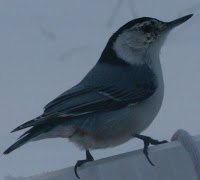
Other birds that will provide organic pest control in our garden include the American Goldfinch, the slate-colored Juncos, the Blue Jays, the White-breasted Nuthatch, the Northern Cardinals, and various sparrows. I'll still put out some black oil sunflower seeds (maybe even plant some black oil sunflowers) to keep them all hanging around, but if they want some protein, they'll have to eat my bugs.

 , the sugar substitute in Equal, which kills ants when they eat it. Since I know he doesn't want anything even potentially dangerous around his kid, I shied him away from the faux sugar and pointed him toward some new tactical weapons in the looong war.
surrounded by diatomacious earth
with howitzers of ant chalk laying down circles of indirect fire support in the gaps in our front line.


 , which rabbits and deer love. They'll stop and eat the clover and be happy with it, never making it deep into the garden where the expensive goodies are. Occasionally there's a deer (like our regular visitor, Scarface, shown here), who gets deep into the garden where he's learned to love pea shoots (who doesn't). In that case I use
  , another barrier--one that sends scarface running for the nearest water.


