Showing posts with label organic gardening answers. Show all posts

Saturday, September 04, 2010

Mort Mather's Garden Spot

Mort Mather organically gardening at his home in Maine.

Back in 1996, I was contacted by Mort Mather about publishing his organic gardening articles on line. I was just in there cleaning up some things and I got to reading some of the articles. What a treasure! Anyone interested in organic gardening should check out the Garden Spot and read some of Mort's informative articles.

Mort likes to say that the soil is your bank, and you won't be able to make withdrawals unless you make deposits. Of course, the best kind of deposit is compost. This time of year I find myself grabbing bags of cut grass and leaves to add to the pile, so I'll have plenty of compost to add to raised beds in the spring.

"The land is our bank. Making deposits is a high priority."

Mort's also a big fan of worms, as are all of us organic gardeners. This article has a great conversation with a non-organic gardener about the importance of worms in your garden.

In short, Mort's idea is that healthy soil creates healthy plants which are naturally pest and drought resistant. For more on growing healthy plants in healthy soil, spend a little time in the Garden Spot or with Mort's book, Gardening for Independence.

Sunday, January 24, 2010

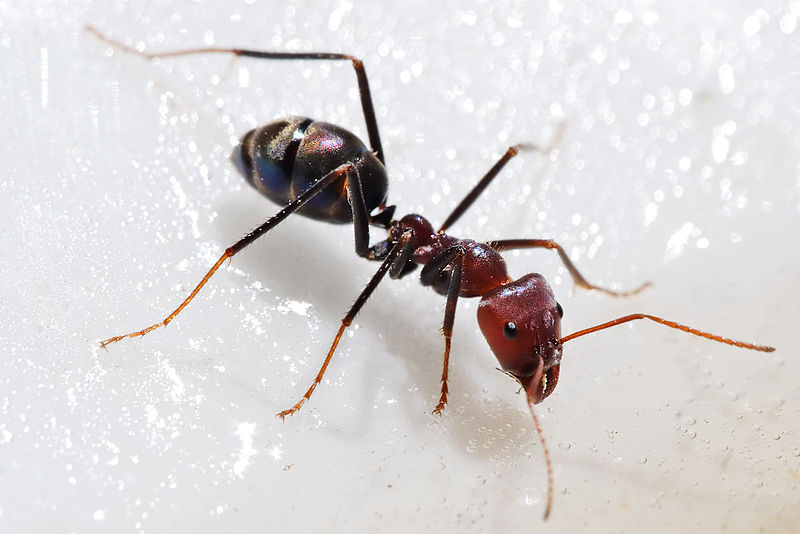
Ant Wars!

Photo by Fir0002/Flagstaffotos
A very good friend of mine from my stagehand days recently bought a house--a fixer upper in ant country--and asked for some help on that front.

Ants go where the food is, so first, make sure there's nothing for them to eat. This is most important! Cut off their supplies!

Now the battle can begin!

Put out the ant baits you can buy anywhere, but put them outside near their homes. I used to use those metal stakes that go in the ground. They work for a while, but eventually they learn to avoid them, so you have to keep changing brands. This is the artillery to soften them up a little.

Find where they're coming through the wall. Unless they're under the house, or living in the house somewhere, they're coming in through a crack, usually around a cable inlet hole or window. Caulk. You want to seal the holes anyway, for energy efficiency.

Now you're going to have to launch an attack on their fort. Follow their trail back to the home. If you don't care about growing anything in that spot for a while, pour a bunch of vinegar down the hole. Get the 10% vinegar if you can find it, but 5% is OK. If you dig the area up after wards and compost the soil with some grass clippings and food waste, it will balance out the pH and you can use the soil again.


If you do want to grow something there immediately, you can get some Diatomaceous Earth--not the kind for pools, but the finer kind used to kill bugs--you can pile it on the mound and in a radius of a foot or so, more if it's big. The powder is so fine it clogs the breathing pores in their skin. Be sure not to breathe the stuff, as it will do the same to your lungs. They will die trying to get out. In fact, they will build a bridge of dead ants and crawl over them, so you have to keep going there, raking the area free of dead any bridges, and reapply as needed. Watch for places where they try to tunnel out, and apply there to. Obviously, you're going to have to be patient and vigilant. Kind of like democracy.

If you really want to have some pyrotechnic fun, I suggest gasoline of kerosene. Not exactly organic, but you're going to let it soak in and then light it up. Careful. I suggest some sort of fuse so you can stand back when the fire geyser spews flaming ants into the sky.

If they're really bad, there is an ant chalk that is technically illegal, but they sell it in Chinatown. It has a neurotoxin in it, so use gloves, and make sure the kid can't get near it. It's not technically organic, although a lot of people say it is. The active ingredients are Cypermethrin and Deltamethrin, which are both common, very weak insecticides which break down quickly (but are really bad for fish, so don't use near water). They are both Pyrethroids, synthetic chemicals that very closely resemble pyrethrins, which come from flowers. This is what a lot of ant sprays have in them, but I hate sprays as a lot of it gets in the air that way. Besides, they stink for days after you spray them.

Draw chalk lines where the ants are coming into the house, on concrete it works well, you have to press hard to make sure it gets into the stucco. They will not come back for a long time once they get a taste of that stuff.

Finally, learn to live with a few of them. Too many and there's obviously a food source available, so again, make sure every thing's sealed up. Battle them back as much as possible, but there will always be scouts. Kill them when you see them, but no need to freak. They're actually pretty clean, an amazing evolutionary engineering wonder. The colony acts like a single brain (I often call it the ant brain).

And they're just doing their (very important) job....

Thursday, February 12, 2009

Investing in an Organic Pest Control System

This summer, our slightly inclined backyard will become a terraced, raised bed, intensive organic garden, producing enough food to keep our family, and friends, in fresh produce as early as mid-spring, through the summer, and into next winter. The small area I managed to build up when we moved in in August will be quadrupled, or more if you count the pumpkin patch I'm planning. I'm already making arrangements to get a load of manure dumped right onto the snow, as I've seen the local corn farmers doing already.

Of course, this sudden transformation of yard will be a beacon to the local insect population, especially if any of my plants are weakened by cold weather, drought, or nutrient deficiency. I'll try to protect them, plant them at the right time, water if I have to, and make sure I've put enough manure and compost in the soil to keep them healthy. But if you grow it, the bugs will come try to eat it.

Black-capped ChickadeeSo, this winter, I've been investing in a locally integrated and organic pest control system: birds. I've spent about $10 so far on suet and seeds (avoiding thistle, which the finches love, but often pass whole, leading to more weeds to pull). The most numerous species by far are the intelligent state bird of Maine and Massachusetts, the Black-capped Chickadee. They are voracious insect eaters in summer, when I will stop providing suet for their protein source. The Chickadees especially love mosquitoes, which won't really hurt plants, but do hurt the gardener.White Breasted Nuthatch

Birds are an elegant solution to pest control, but humans, of course, screw up the system. Pesticides are bad news for many reasons, not the least of which is that they harm bird populations. When I was young, I had an organic epiphany when I saw dead lady bugs that would have eaten the aphids we were trying to kill with the stuff that killed the lady bugs. Now I wonder why anyone would want to spray a synthetic, petroleum derived chemical that depletes bird populations in order to kill the bugs that the birds would eat: yet another interminable succession of absurdities.Blue Jays

Other birds that will provide organic pest control in our garden include the American Goldfinch, the slate-colored Juncos, the Blue Jays, the White-breasted Nuthatch, the Northern Cardinals, and various sparrows. I'll still put out some black oil sunflower seeds (maybe even plant some black oil sunflowers) to keep them all hanging around, but if they want some protein, they'll have to eat my bugs.

Wednesday, November 12, 2008

The Organic Gardening Guru is Taking Questions


My friend Mort Mather is taking organic gardening questions, at least for the winter, over at his Happy Blog. Mort was president of the Maine Organic Gardening Association, and grows an awesome garden that supplies his son's southern Maine restaurant.